Friday, 18 March 2011
Freddie Wong: How to create a realistic Muzzle Flare
Freddie Wong is a graphics wizard. We found it difficult to create a decent muzzle flare, problems included:
- Making the flash look realistic (and in perspective)
- Obtaining an optimal size for the muzzle flash
- Achieving realistic lighting (given off by the flash)
- Timing the flash with the action/sound
Freddie Wong's tutorial was perfect. It goes through steb-bystep how to create a believable muzzle flash and using his expertise we ended up with an incredible shot effect and possibly the best individual piece in our film sequence.

Tuesday, 25 January 2011
Alternative Idea: 'The Chase'
After a difficult Group Meeting we concluded that without the right location, Matt's original Idea would be difficult to produce, therefore we decided that everyone should come up with a new idea and pitch it to the group.
This is my idea:
Lucas is a 16 year old teenager and his father has been vigorously training him in all sorts of activities, particularly fighting. Little does he know, that his father is an M16 agent, who knows lots of key M16 information and he has been training Lucas so that he is able to protect himself and overcome adversary.
In the sequence we see Lucas, coming home from school, with his headphones on and just strolling down the street. The camera then cuts to a POV of Lucas and we see a strange black-clothed teenager of a similar age who is leaning against a wall, opposite him is a black 4x4 with its boot open. As Lucas walks past the teenager he gets attacked and pushed towards the 4x4. He squints his eyes and thinks about his training and Lucas recovers and knocks the teenager to the ground. He then paces down the street and gains at least 10 metres before the teenager gets up. He then runs around a corner and hides, however a sports car (my dads car) skids towards him and the driver indicates to the teenager for him to chase Lucas. Lucas then sprints towards his house and presses a back gate button (Match on Action) and then runs into his garden and then he shuts the gate and loses the chasers.
The idea is that another evil agency have been bringing up teenagers to fight against the government and cause trouble. They attempt to kidnap Lucas in order to use him to catch his father and obtain his knowledge. However, they do not expect Lucas to be so skilled and they fail. Now there are two different storylines, which are as follows. This agency manages to catch Lucas' Father and Lucas fights his way into the evil agency to get his father back.
A quick storyboard I created illustrating the idea in a visual way

One aspect of the storyboard, involving the main character concentrating. It is a CU of his face and his eyes are squinted and to one side preparing the audience for a flashback:
Monday, 24 January 2011
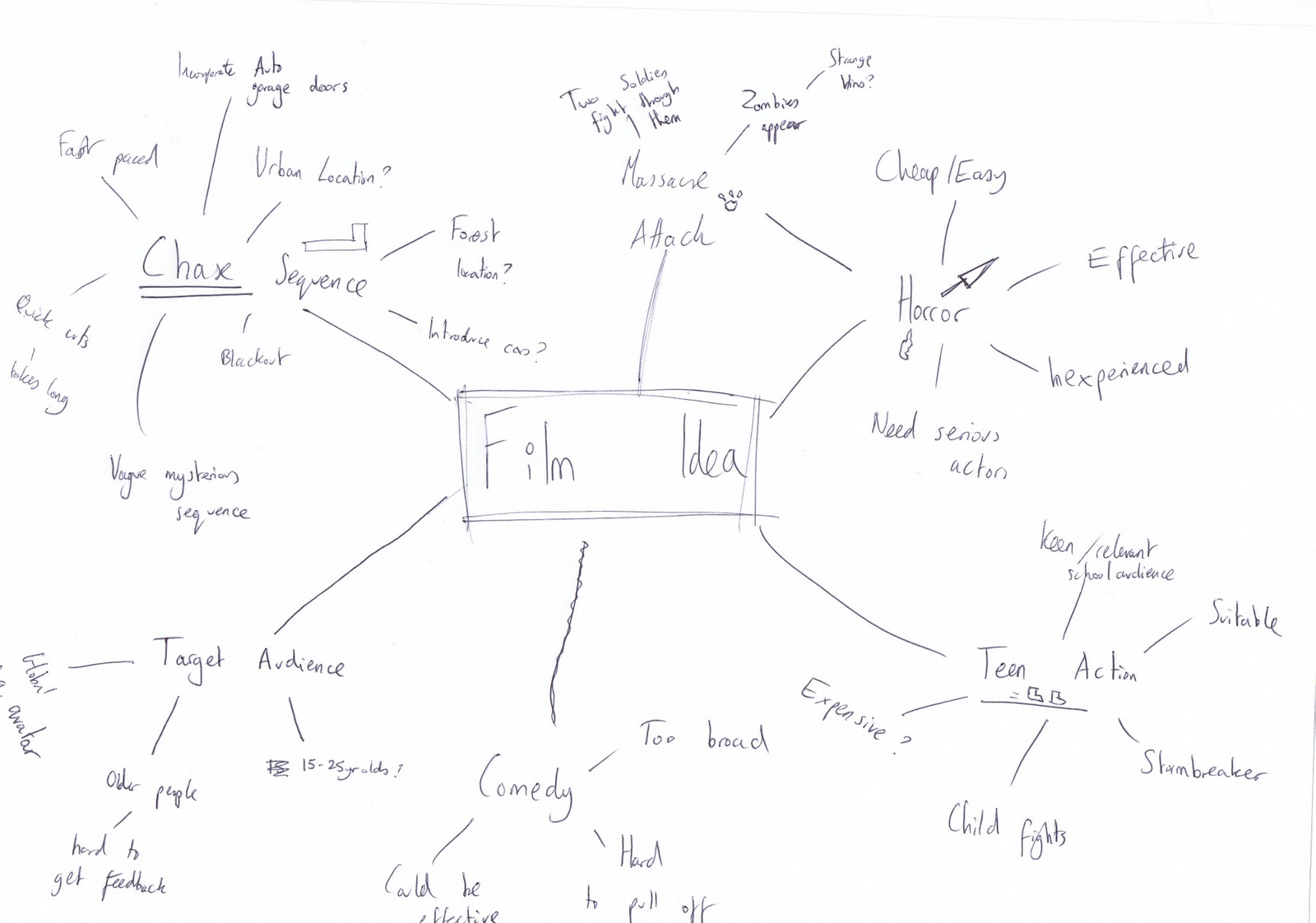
Brainstorm - Film Sequence Idea
Here are ideas I went through with a brainstorm, I ended up deciding on a 'Chase' idea, as I know numerous actors who we could cast and it would also be effective in my local area as we could incorporate cars to add to the drama and I have quite a quiet area. We could also use my automatic garage doors.

Saturday, 22 January 2011
Location Research
Ravenscroft Park is a quite and residential park. This park is a potentially effective location for our media opening sequence. It's not always good to film outside, due to weather and distractions, however it has plenty of horrific features, while maintaining a rural feel.


 Another location is my cellar, which again has strange components. There are lots of holes in the walls and it's a very plain area, which could be made into a complete mess. A benefit of this location is that it is indoors and rain or too much sun will not affect the footage.


Monday, 18 October 2010
Preliminary Exercise - Evaluation
Evaluation
Preliminary Exercise: Continuity task involving filming and editing a character opening a door, crossing a room and sitting down opposite another character, with whom he/she then exchanges a couple of lines of dialogue. This task should demonstrate match on action, shot/reverse shot, and the 180-degree rule.
--------------------------------------------------------------------------
1. Who did you work with and how did you manage the task between you?
I worked with Michael Cassidy and Eoin Brogan. There were only three of us, so we managed the task to ensure that each person contributes to a third of the task and that we achieve maximum efficiency in one hour.
For the planning we gathered in our spare time, and each individually contributed to making the video what it is now.
For the filming I acted in the first scene as the 'bully's friend', I then filmed the majority of the rest of the task. Michael took part in the filming of the first scene, he then acted as the 'nerd' for the rest of the film. Eoin played the role of the main actor, 'the bully' and he was shown in all scenes.

The editing was lead by Eoin Brogan, with myself and Michael Cassidy contributing towards what is chosen and different ways of editing the outcome, e.g. the volume change between the shot where Eoin says, 'so you gonna do my howework as well then?', and when he repeats himself and stands up to the nerd.

2. How did you plan your sequence? What processes did you use? What theories did you try to take into account?
We used three key documents in order to ensure that our film was as good as possible, and the shooting was as efficient as possible:
- Storyboard
- Shooting Schedule
- Script.
SB1 Rotated
The shooting schedule was important for efficiency, one problem was that our group and another group wanted to shoot in the hall leading to the classrooms, therefore we had to plan to ensure that we didn't shoot at the same place, at the same time. We also had some scenes almost overlapping, so we put them together in the schedule.
SS Rotated
The script was used to plan what is said by each actor and make sure it makes sense and portrays their character type, e.g. the bully needs to sound tough.
The Bully Script
We ensured that continuity was taken into account when producing our film sequence. We used shot order to make sure that our shots made sense and flowed well. We used the 180 degree rule to not confuse the audience and to also make sure the sequence appeared to make sense. We used the eyeline match for the point of view shots and the shots where you cannot see both actors. Match on action was used when Eoin grabbed the door to open it and when Eoin grabbed the chair, it was used to make it seem smooth. Shot/reverse/shot was also used in the conversation to maximum effect.
We took the following theorists into account when planning/filming our sequence:
- Tzvetan Todorov
- Claude Levi-Strauss
- Roland Barthes
Levi-Strauss looked at narrative structure in terms of binary opposites:
- Earth vs. Space
- Good vs. Evil
- Humans vs. Aliens, etc...
Roland Barthes created a theory involving 5 codes:
- Enigma Code - Elements of a film which are a mystery at first, however are slowly revealed as the film progresses
- Action Code - This applies to any action that implies a further narrative, it is closely related to the text's narrative structure
- Semiotic Code - Mainly to do with 'connotation'
- Cultural Code - The points at which the text refers to common bodies of knowledge
- Symbolic Code - It exists to explain the complexities of an element of the text
3. What technology did you use to complete the task, and how did you use it?
We used the following equipment in the process of creating the final film sequence:
- Video Camera
- Shotgun Microphone
- Clapperboard
- Adobe Premiere (editing software)

The clapperboard was used to keep track of our scenes/takes, and to make sure we had covered everything. It was also useful before we filmed as we could clap the board to indicate the start of a capture.
We used a tripod to keep the camcorder still and to make smooth camera movements. It was also used to help with the eyeline matches.

Adobe Premiere was our editing software. This was completely new to me as I just started media this year. I found it quite straightforward and very detailed, as I have used a simple editing programme in the past.
4. What factors did you have to take into account when planning, shooting and editing?
We were assigned just 1 hour to plan, 1 hour to film, and 1 hour to edit; all in all totalling to 3 hours, therefore time was a huge issue. We had to be as efficient as possible, and plan effectively. We planned quickly and effectively. We drew quick stick figure pictures for the storyboard, and drew out a rough script/shooting schedule. For the filming we took as little takes as possible, as long as the take was decent, for example we only took two takes in certain shots, e.g. the opening of the door.
We had to make sure that the hall leading to the main room was free so that no-one got into our shot and we didn't clash with group 1E who also wanted the hall. Another problem was that we were in a school so people often walked past the door that we enter through, however it is important to show that we are in a school, so any people walking past could be a benefit, as long as they wouldn't make a fool of themselves, e.g. waving to the camera.
We also needed to take into account the sound produced within our film sequence, and around it. Therefore we had to choose appropriate mic settings so that you could hear that we are in a school, but also so that the attention is focused on the actors and not the backround sound.
We also had to make use of the space we were assigned, which was one room and anything leading to it. It would be difficult to get permission to use other areas of the school and to use them effectively.
5. How successful was your sequence? Please identify what worked well and with hindsight, what would you improve/do differently?
I believe that our film was extremely successful, fairly unique and greatly produced.
A great part of the film was the narrative flow between shots, for example the match-on-action in the CU was perfect when Eoin grabbed the door (0:21). This made our film great and viewers often notice small problems which could affect their experience, therefore this made our sequence better.
Most groups used the match-on-action in the grabbing of the door, however I love the use of the return to the door when it closes at (0:24). This is very unique and looks great in our sequence.
The choppy cuts at the end of the film are interesting and exciting. They build up pace and make the ending very dramatic. The finishing shot leaves us on a slight cliffhanger and is created perfectly.
There weren't any major problems with our film sequence, however a couple of minor hitches were noticed after the sequence was edited/published.
A slight problem was perhaps in the MS when the bully grabs the chair. The fluidity between shots is slightly off, and this could provoke confusion or annoyance from the audience. (0:29)
The camera is a bit wobbly at (0:28) when I arc the camera and follow Eoin. This is quite annoying, but time was limited and this was a hard shot. Nevertheless, it is a problem as it distracts the audience.
Overall I am happy with the end result and I will ensure that in the future I will apply the knowledge I have gained to my media coursework.
6. What have you learnt from completing this task? Looking ahead, how will this learning be significant when completing the rest of your foundation coursework, do you think?
This is my first year doing Media, therefore I have learnt a lot in a short space of time. This task progressed my camera skills and the process of keeping shots fluid. It taught me that you don't need to be elaborate and exciting to make a good film sequence, simplicity and originality is much more important. I learnt a lot relating editing and how to cut takes, and blend sound accross shots. I developed my knowledge of continuity theories and how to keep the 180 degree rule. In the future I will remember what I've learnt and further improve on my undestanding of Media Studies.
Thursday, 14 October 2010
Applying Barthes 5 codes to film
James Bond: Casino Royale - Opening Sequence
Enigma Code: Who is this mysterious old man? What is he doing? Is he good/bad? Why is James Bond at a cricket ground? Why does he kill the asian man at the cricket ground? Why James Bond at Prague, in this particular office?
Action Code: The old man draws his gun, this creates tension as the audience is unclear as to what the outcome will be...will the old man kill Bond? How will Bond defeat him? Eventually he attempts to shoot Bond, however Bond has cunningly removed his elder foe's ammo, making it impossible to shoot Bond.
Semiotic Code: Gun = Anger/Purpose/Power/Evil, Darkness = Evil/Mystery/Action, Black and White = Flashback/Mystery, Toilet(in this context) = Isolation/Freedom.
Cultural Code: Cricket is the most appreciated sport in the middle east. Suits are a common attire of the upper class or people with something to hide, e.g. spies.
Symbolic Code: This is similar to semiotic code, the gun symbolises power/evil and adds tension to the scence. The Dark Lighting, and Black and White picture symbolizes mystery. The choice of the toilet for the fight in Pakistan, symbolises isolation and freedom.
Tuesday, 12 October 2010
Applying principles of continuity into film
Never Back Down
Never Back Down (up to 07:00)
The first specific continuity application is when Jake Tyler (the 'protagonist') grabs his rival's helmet; we see match on action as the first shot shows him grabbing the helmet, and the next shot is a close up of him grabbing the helmet. We also see an eyeline match as the camera cuts from close ups of face to face.
This scene is followed by a conversation between the protagonist and his friend. Lots of continuity techniques are applied here. The eyeline match is perfectly demonstrated, for example at (3:21), we see Jake Tyler looking up at his friend and their eyelines are matched perfectly. The 180 degree rule is well applied as the camera never crosses the 'invisible line' and it always stays on the same side, so we never see one perspective which could confuse the audience. Shot/reverse/shot is used perfectly in this conversation. The scene begins with a master shot of the dressing room, it then moves straight into the conversation and cuts from actor to actor.
We see an establishing shot of the house in the next scene, so that shot order is applied as the audience should have a sense of where the scene is taking part. Lots of eyeline matches are used, between Jake's younger brother, himself and his mother. The 180 degree rules is used again, as we never see the wall opposite the kitchen.
Shot order is used in the next scene, as there isn't a huge jump between shots; there is a cut between a Long Shot to a Mid Shot/ Mid Close Up. The shots also stay quite constant (most are mid shots), hence not making the scene too confusing. Match on action is used at (5:42), when Jake Tyler reaches for the box we see him move his arm towards the box and in the next shot we see him put the clothes back into the box.
The 30 degree rule is effectively used when the protagonist and his brother speak from behind the van. The camera angle stays constant as it flicks between each speaker.
In conclusion, this clip is an example of all the features of continuity. Shot order is maintained effectively, and the sequence consistently makes sense from shots, e.g. the zoom into shots at Florida is used well. The 180 degree rule is also maintained, therefore the viewer can always comprehend, and stay focused on the film.
Subscribe to:
Posts (Atom)